The Effect of Message Repetition on Information Diffusion on Twitter: An Agent-Based Approach
At the Pragmatics laboratory, we have published an article in the journal IEEE Transactions on Professional Communication. DOI: https://doi.org/10.1109/TPC.2023.3260449
ABSTRACT:
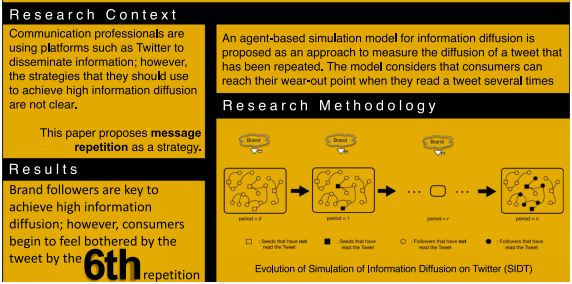
Twitter offers tools that facilitate the diffusion of information by which companies can engage consumers to share their messages. Literature review: Communication professionals are using platforms such as Twitter to disseminate information; however, the strategies that they should use to achieve high information diffusion are not clear. This article proposes message repetition as a strategy. Research questions: 1. What is the wear-out point of Twitter? 2. How many times should a company repeat a tweet written on its brand page to maximize the diffusion for seeds? 3. How many times should a company repeat a tweet written on its brand page to maximize the diffusion while minimizing the number of consumers reaching their wear-out point for seeds? 4. How many times should
a company repeat a tweet written on its brand page to maximize the diffusion for non-seeds? 5. How many times should a company repeat a tweet written on its brand page to maximize the diffusion while minimizing the number of consumers reaching their wear-out point for both seeds and non-seeds? Research methodology: An agent-based simulation model for information diffusion is proposed as an approach to measure the diffusion of a tweet that has been repeated. The model considers that consumers can reach their wear-out point when they read a tweet several times. Results: The results of the model indicate the number of times a company should send the same tweet to achieve high information diffusion before this action has negative effects on consumers. Brand followers are key to achieving high information diffusion; however, consumers begin to feel bothered by the tweet by the sixth repetition. Conclusions: To the best of our knowledge, this is the first study to examine tweet repetition as a strategy to achieve higher information diffusion on Twitter. In addition, it extends the information diffusion literature by controlling the wear-out
effect. It contributes to both communication and computational science literature by analyzing a communication problem using an agent-based approach. Finally, this article contributes to the field of technical and professional communication by testing a strategy to reach great information diffusion, and by creating a tool that any company can use to anticipate the results of a communication campaign created in Twitter before launching it.