A Reflective Architecture for Agent-Based Models Applied to Social Network Sites

Share
A Reflective Architecture for Agent-Based Models Applied to Social Network Sites
We have published and presented this paper at the International Conference on Enterprise Information Systems (ICEIS 2024). DOI: https://doi.org/10.5220/0012615100003690

ABSTRACT:

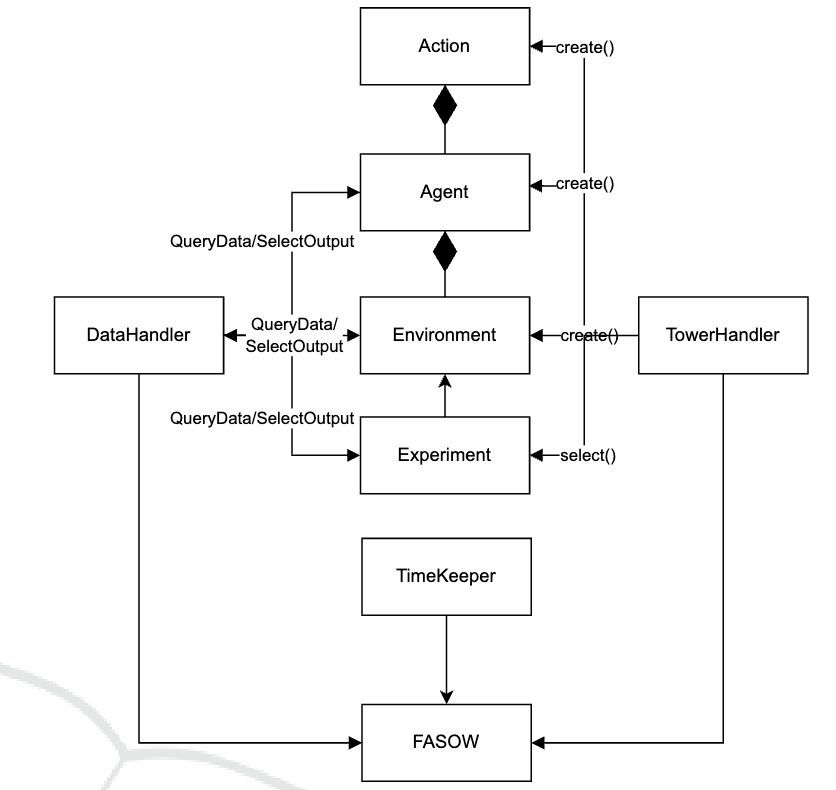
Social network sites serve as effective platforms for word-of-mouth marketing (WOM), often analyzed through Agent-Based Models (ABMs). However, implementing ABMs can be daunting, with programmers facing
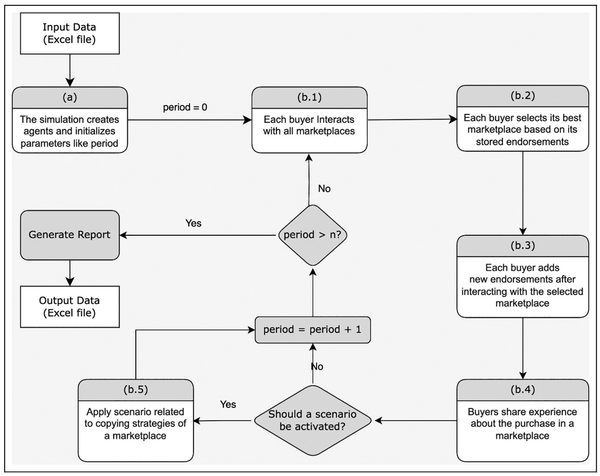
the choice of building from scratch or using frameworks. To tackle this, we propose FASOW (Flexible Agent Simulator for Open WOM) architecture, employing the Reflective Tower design. FASOW’s four layers cater to varying complexities, simplifying implementation by breaking down models into manageable sub-layers. We validate FASOW through a case study on Twitter, examining agent saturation effects in WOM marketing. Results indicate FASOW’s efficacy, though further use cases are needed for comprehensive evaluation. Additionally, we offer an online proof-of-concept for this architecture.
Read more

Factors that Drive Market Share and the Oligopolistic Character of Cross-border B2C Ecommerce: An agent-based scenario analysis approach

Factors that Drive Market Share and the Oligopolistic Character of Cross-border B2C Ecommerce: An agent-based scenario analysis approach

We have published this paper in the journal Simulation: Transactions of the Society for Modeling and Simulation International. DOI: https://doi.org/10.1177/00375497241296542 ABSTRACT: Business-to-Consumer (B2C) e-commerce has become a dominant, continuously evolving force in global retail. Most consumers today make cross-border purchases in

By Paul Leger
Efficiency Analysis of Engineering Classes: A DEA Approach Encompassing Active Learning and Expositive Classes Towards Quality Education

Efficiency Analysis of Engineering Classes: A DEA Approach Encompassing Active Learning and Expositive Classes Towards Quality Education

We have published in the journal Environmental Science & Policy. DOI: https://doi.org/10.1016/j.envsci.2024.103856 ABSTRACT: The science, technology, engineering, and mathematics (STEM) education research delves into the core of sustainable development goals (SDGs), including the pillars of quality education (SDG4), robust economic growth (SDG8)

By Paul Leger