Layer Activation Mechanism for Asynchronous Executions in JavaScript
A new paper is accepted in the Context-Oriented Programming workshop, where the authors are: Hiroaki Fukuda, Paul Leger, and Nicolás Cardozo (To appear). Here is the abstract:
In modern software development with JavaScript, an asynchronous execution model is often adopted to prevent freezing execution triggered by the blocking operations. JavaScript is now used in various types of applications for the Web, smartphones, and serverside due to its rich ecosystem. In such applications, programmers implement several concerns that should perform different behavior according to the current identified context. Context-Oriented Programming (COP) posits layers as an abstraction to manage such
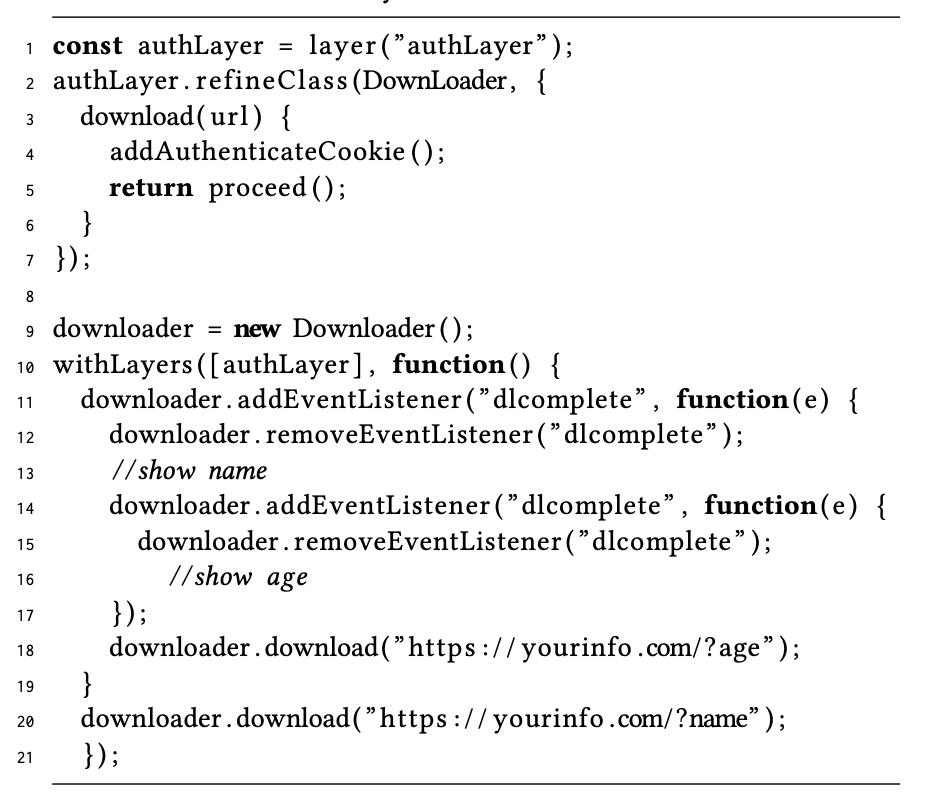
concerns. With COP, programmers can implement context-dependent application behavior in a layer, then (de)activate such layers when the context changes, leading to a change in the system behavior. Additionally, COP offers different scoping strategies which define when and how layers should be (de)activated. The dynamic extent of layers is one of such scoping strategies, which encapsulates the duration of a layer within a block, then deactivates the layer when the block execution ends. However, applying an asynchronous execution model breaks the semantics of dynamic extent because the result of an asynchronous execution generally returns when the caller of the asynchronous execution goes through the block. Existing work proposes a variant of the dynamic extent that activates a layer for a block and its logically-connected asynchronous operations by keeping information across them. However, that proposal only supports one of three kinds of asynchronous operations used in JavaScript (MacroTask, EventTask, and MicroTask). This paper extends on the existing work to support a layer
activation mechanism with a scoping strategy that fulfills all three kinds of asynchronous operations in JavaScript. We show the benefit of our proposal through the implementation of a real-world application for smartphones.