Evaluations of Integrated Programming Environment for First-Year Students in Computer Engineering
A new paper has been accepted in the Journal of Universal Computer Science, where the authors are: Matias Salinas, Paul Leger, Hiroaki Fukuda, Nicolás Cardozo, Vannessa Duarte, and Ismael Figureoa (To appear). Here is the abstract:
Many factors influence the problems that currently exist in the learning-teaching process of programming. The use of an Integrated Development Environment (IDE) makes the experience a complicated process because these IDEs focus on professional programmers and not on novice learners. This also affects the classrooms of the university “Pontificia Universidad
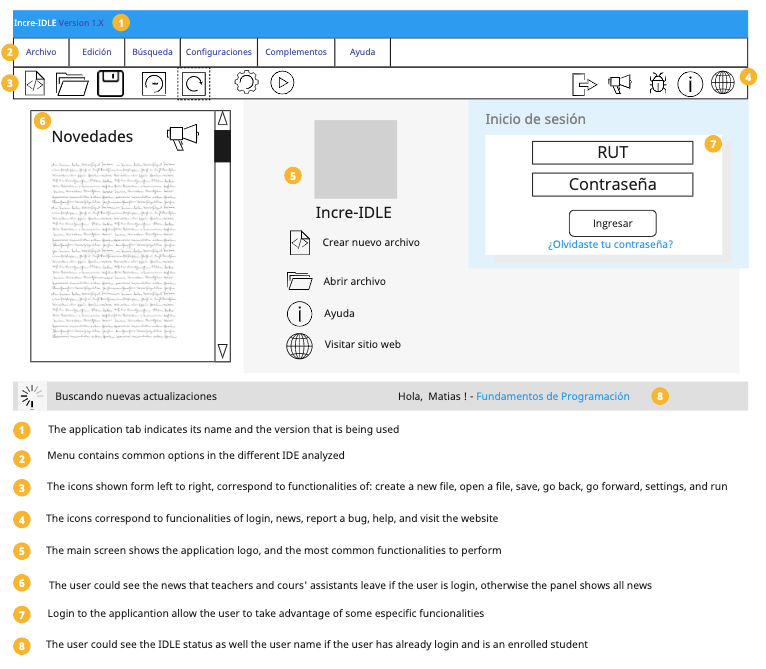
Católica de Valpara ́ıso (PUCV)” (Chile). The use of professional IDEs negatively affects the learning process of first-year students who face the development of the algorithms for the first time. One of the IDE widely used for teaching programming courses is Code::Blocks, which is a tool for professional developers. Through a heuristic and usability evaluation, we found that Code::Blocks has a complex user interface and a functional overload. Using these two findings, as well as recommendations given during these tests, we highlight the important aspects that an IDE for novice learners should have. Taking into account previous observations and state-of-the-art/practice of IDEs, a functional IDE prototype, named Incre-IDLE , is developed. In addition to Code::Blocks evaluations, this paper reports the results of a heuristic and usability evaluation applied to first-year students at PUCV about functionalities provided by Incre-IDLE. These results suggest that Incre-IDLE has a simple interface, is easy to install and use, and does not have functional overload (i.e., spend a considerable amount of time learning the tool). Concretely, the results show that 66.7% of the students could complete tasks easily and 100% of them found the GUI intuitive. In terms of GUI, 83.3% considered the application interface “very simple”; and the text, concepts, and icons “very understandable” by 66.7%. The
students also found the tool “motivating” (66.7%) or “very motivating” (33.3%). These results closely match the findings obtained by the heuristic evaluation of Incre-IDLE from the experts: 83.3% of them rated it as “useful” or “very useful”, and only a 16.7% rated it as “useless”.