Defining SPL Scope in Small Companies
A high impact article named "A Collaborative Method for Scoping Software Product Lines: a Case Study in a Small Software Company" was accepted in indexed journal Applied Science (IF = 2.458). This work was developed with members of Colombian and Chile.
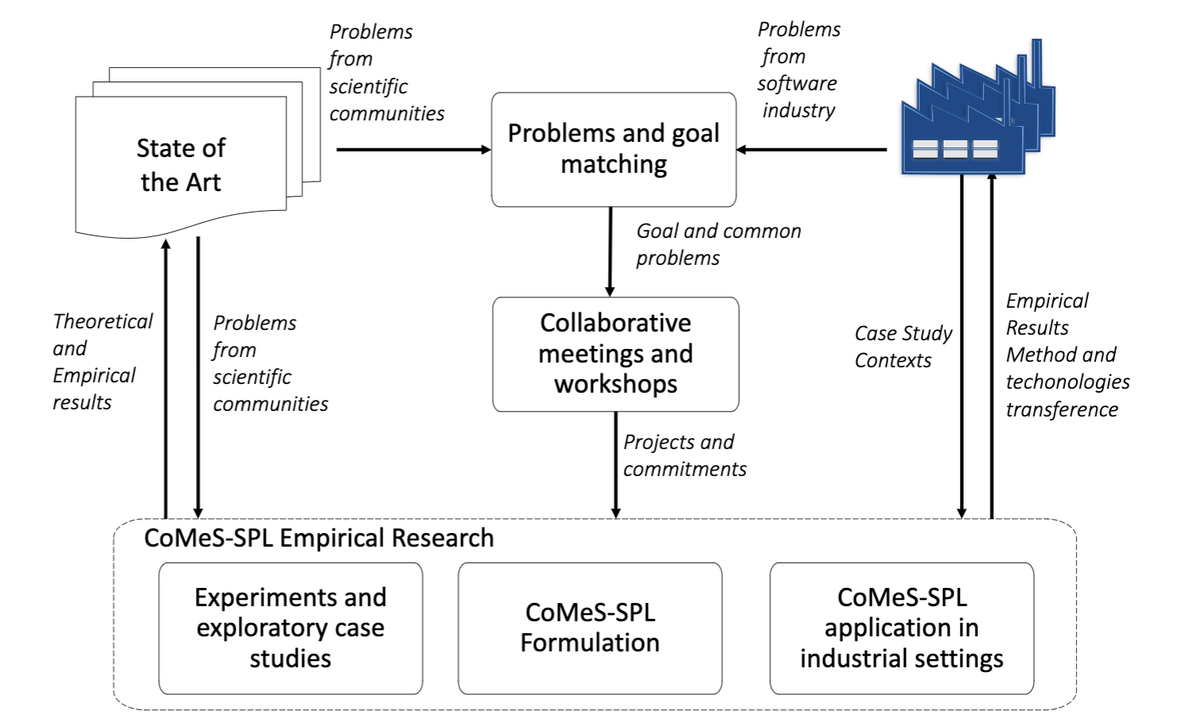
Abstract: SPL scoping is the activity for bounding Software Product Lines (SPL), gathering heterogeneous knowledge from diverse sources. For achieving an agreement among different stakeholders, a commonalty scope must be understood and committed to. However, gathering this knowledge from stakeholders with individual interests is a complex task. This paper reports the experience of scoping the SPL of a small Colombian software company, applying and evaluating a collaborative method called CoMeS-SPL. The company was looking to develop a set of products from a product previously developed with great potential to be adapted and sold to different customers. From a collaborative relationship university–enterprise model, the research groups that developed CoMeS-SPL proposed to use it answering to the company needs for defining an organization-suitable reuse scope around its platform called CORA. Both parties joined in the scoping co-production of the first SPL of the company. This method implied that the company would perform new tasks and involve other roles different for those who are used to defining the scope of a single product. The company actors considered that they obtained a useful scope and perceived the collaboration as valuable because they shared different knowledge and perspectives. The researchers were able to provide feedback on their proposed model, identifying successes and aspects to improve. The experience allowed strengthening the ties of cooperation with the company, and new projects and consultancies are being carried out.