An Expressive and Modular Layer Activation Mechanism for Context-Oriented Programming
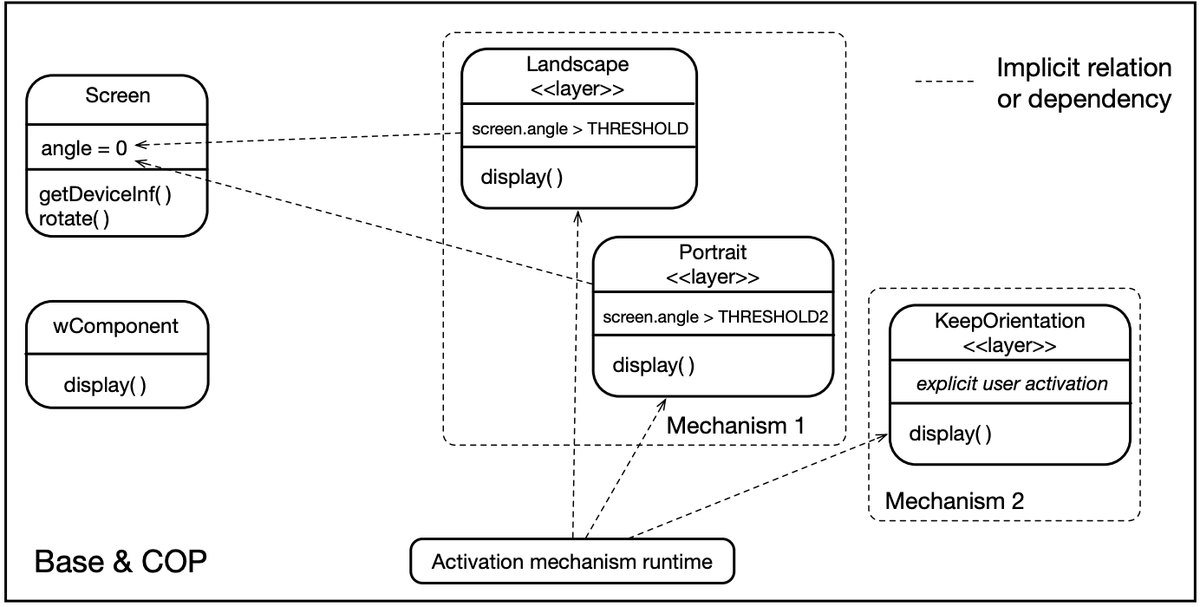
A paper was recently accepted in the journal Information and Software Technology, which develops EMA, an Expressive and Modular layer Activation mechanism, as a JavaScript library for Context-Oriented Programming (COP). You can find the paper: https://doi.org/10.1016/j.infsof.2022.107132
Context. There is a trend in the software industry towards building systems that dynamically adapt their behavior in response to their surrounding
environment, given the proliferation of various technological devices, such as notebooks, smartphones, and wearables, capable of capturing their execution context. Context-oriented Programming (COP) allows developers to use layer abstractions to adapt software behavior to the context. A layer is associated with a context and can be dynamically activated in direct response to gathered information from its surrounding execution environment. However, most existing layer activation mechanisms have been tailored specifically to address a particular concern; implying that developers need to tweak layer definitions in contortive ways or create new specialized activation mechanisms altogether if their specific needs are not supported.
Objective. Complementing ideas to expressively declare activation mechanism models with interfaces that define conditionals of activation mechanisms modularly, this paper proposes an Expressive and Modular Activation mechanism, named EMA.
Method. To propose EMA, we analyze existing activation mechanisms in COP regarding activation features and scope strategies. After, we propose the design of EMA and validate it with a case study discussion.
Results. Using a concrete JavaScript implementation of EMA, named EMAjs,
we can implement two Web applications: a smartphone application as an example to illustrate EMAjs in action, and an application of home automation to discuss and compare our proposal.
Conclusions. Our proposed mechanism allows developers to instantiate different activation scope strategies and interfaces to decouple the declaration of activation mechanism conditionals from the base code.